
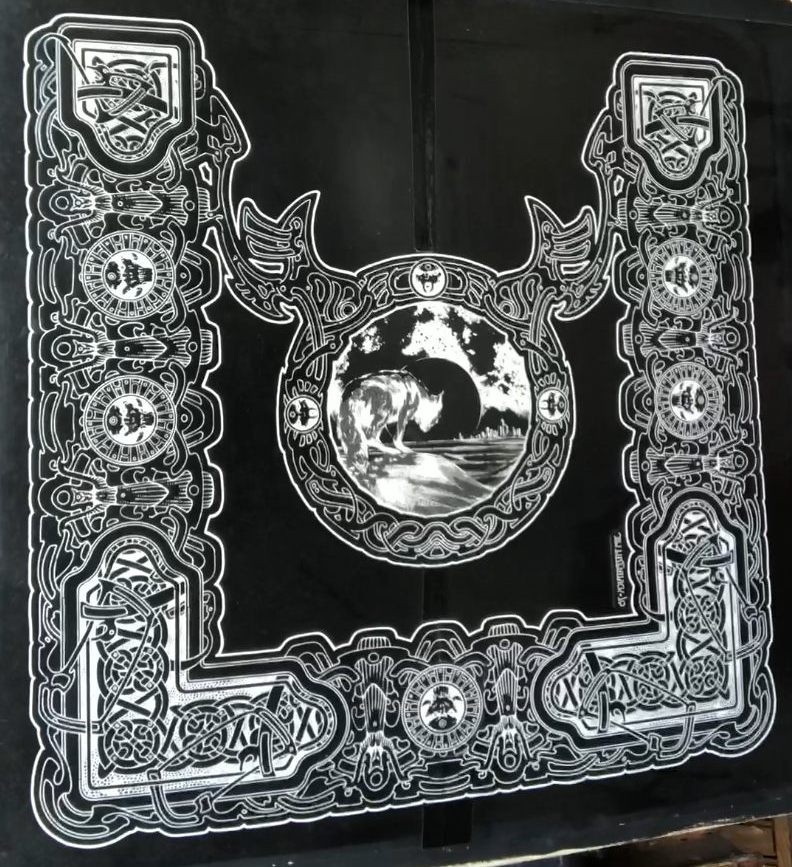
Philip had asked me to get going on some new album covers. Things were moving fast and there wasn’t going to be a lot of time to prepare. We’d been throwing visual ideas around, Planet of the Apes imagery, post-apocalypse, the fall of the Statue of Liberty, and in particular a comic that Philip was reading and was a big fan of, Killraven.

You can see the influence of this Killraven comic cover from 1975, with some of the War of the Worlds elements that ended up being used in Jailbreak. Other notes Philip gave me were that he loved my Celtic Irish art but didn’t want any diddly-aye elements, meaning anything too overtly Irish on the cover. I had done an album cover for Planxty with that kind of Irish imagery and Philip wanted something different.

From all these ideas I got to work and created this rough sketch in 1976, pulling in many of these elements.

I thought Philip would go straight for the warrior image, the jets and the Statue of Liberty. Instead he was blown away by the border. “I love that effin’ border,” he said. Philip had a great eye and I really appreciated that he could see things the way I could. So I went ahead with the border and left out the rest of the artwork.
The border was initially without any Irish or Celtic design elements. I was being influenced at the time by a French artist by the name of Philippe Druillet and incorporated certain elements of that style into the border.

In this part of the border there are images of skulls but also of cats, reminiscent of Egyptian cats. There’s no real reason for it, though looking back now, in the same year I painted the artwork Palu the Cat Goddess, so I suppose I had cats on my mind.

Once I had done a detailed drawing of the border, Philip asked me to put in some minor Irish elements. I had some Celtic knotwork borders already drawn and ready to go, so with some adjustment I put them in too.

This was a very technical artwork, like most of the Lizzy album covers. After I got the go-ahead from Philip to create the border for a yet unknown album, I made a very detailed pen and ink drawing. I drew half of the border, then created a photographic negative of that half, flipped it over and created another negative. Then I stuck them together perfectly and printed the full negative on lithographic transparent paper. This was then fully painted on the front and back of the paper, including using real gold paint for extra effect.
Personally, and from an artist’s perspective, I consider this my best Thin Lizzy album cover.
Great read Jim! for me it’s a toss up between Black Rose and this in terms of artwork, but I will say this, I think Johnny the Fox is the best Lizzy album!