
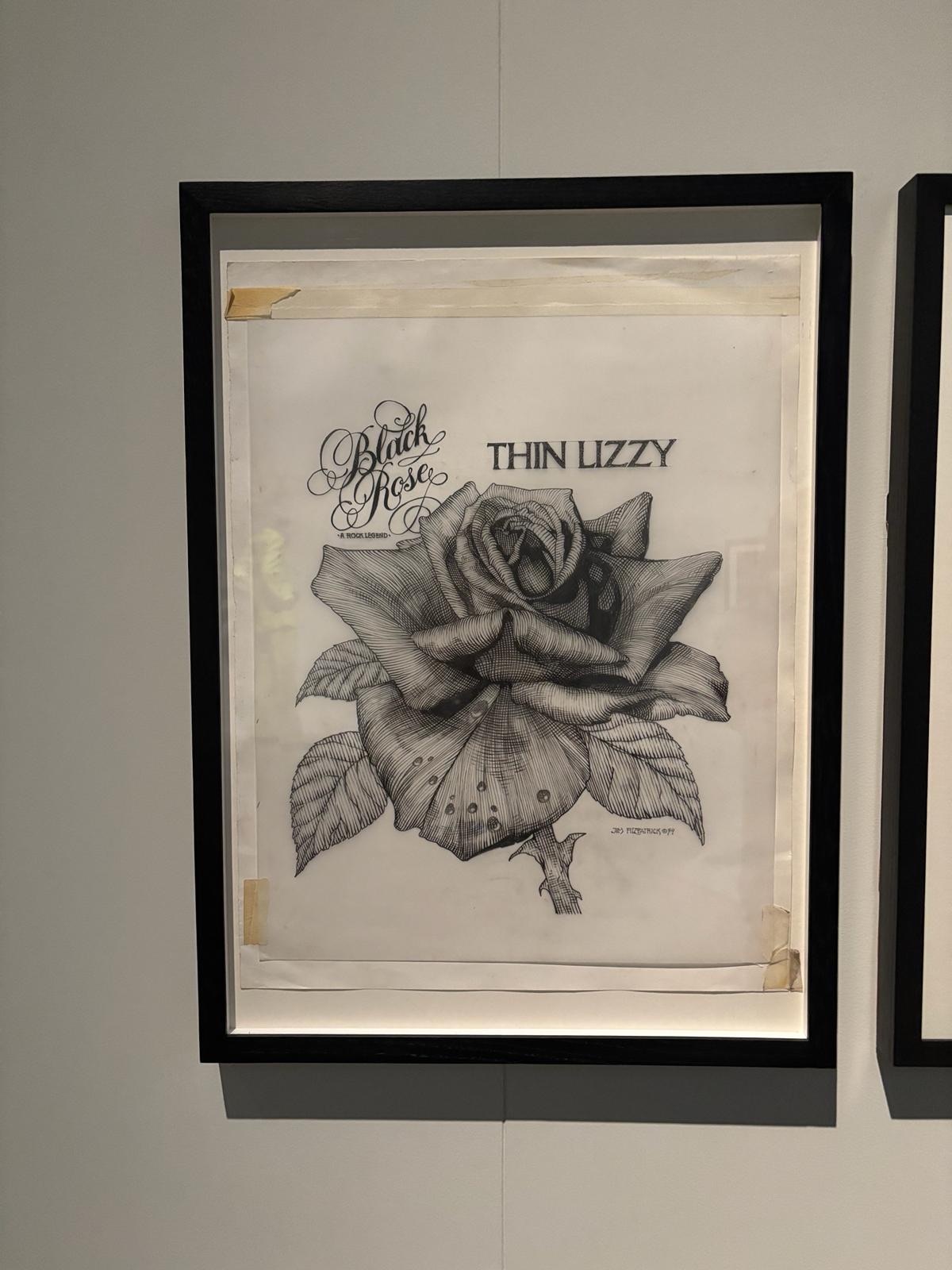
The V&A East Museum in London has a new exhibition called The Music is Black: A British Story. It covers 125 years of Black music making in Britain and it is a stunning piece of work. My original pencil drawing for the Black Rose album cover is in it.
Josephine Small and Jacqueline Springer of the V&A approached me and asked if I would be willing to donate an actual piece of artwork for the exhibition. Not a print. An original. Now, I have dealt with the V&A before and I already have quite a few works in their collection, but to be asked to donate to a major new exhibition in the new V&A East is a huge honour. They are very select. Museums have limited space and they will not just take anything you walk in with. So I decided I would give them something really bloody good.
I gave them the final pencil drawing for Black Rose. It is drawn almost like an etching with all the lines covering the plant. I was influenced at the time by everything from steel engraving to scraperboard work, so the pencil drawing has an intensity to it that I think stands as a work of art in its own right. This was the drawing I worked from when I created the finished painted artwork for the album cover.
I would like to thank both Josephine Small and Jacqueline Springer for organizing all of this, they were great to deal with and I think have done an amazing job.

They wanted Thin Lizzy in this exhibition and rightly so. Philip Lynott was a Black Irishman and Thin Lizzy were based in England and part of the British music scene whether we like it or not. Much as we love to claim them as Irish, in those days you had to leave this country to get anywhere. Philip and Jimi Hendrix were among the very few Black men in rock and roll who were leading bands of white musicians at that time. That is significant and the V&A recognises it.
I was totally on board with something like this. My knowledge of Black music goes way back. My mother had a Louis Armstrong album and she was a fanatical Paul Robeson fan. If anybody does not know who Paul Robeson is, look him up. He is one of my heroes. He had an operatic voice like nobody else and he was a radical, a communist, a Marxist who was banned from entering America at one stage because of his politics. I grew up knowing about this stuff. And when I moved to London I got absorbed into the world of Judge Dread, a white DJ who played nothing but Black music. Beautiful stuff. He got me into Timmy Thomas and so much more. I knew Black music long before I knew Philip and I was also converting him to some of the musicians I loved. But Philip educated me too. He was the first person who turned me on about apartheid. I had a bank account at Barclays Bank and he said no, switch that bank Jim, they support apartheid. I knew about Sharpeville and all that but Philip pushed me to look deeper. So we were cross culture. He was radical in one way, I was radical in another.


My daughter Suzanne visited the museum recently and she was deeply moved by the whole experience. She said for anyone who wants to go on a musical journey it is really inspiring. I would say the same.
Around the same time as the exhibition opened in London, I was in Dublin at Liberty Hall where the Unite trade union had put up a massive banner taken from one of my works. It features Philip’s image and reads Black Irish and Proud of It, No to Racism. There I was, standing in front of that newly reprinted banner in all its glory while my artwork was going on display in the V&A. I could not help but think if Philip were alive today we would have gone over to London together to see the Black Rose drawing and his photograph in that exhibition and then come back to Dublin to stand in front of that huge banner together. It is an awful pity he did not live to see what he accomplished. It is quite monumental.
No matter where I go, because I am associated with Thin Lizzy, people want to talk to me. They just want to hear even a word about Philip. It makes their lives because they admire him so much. And I am lucky to be a living witness still at 82.

The Music is Black: A British Story runs at the V&A East Museum, 107 Carpenters Road, London E20 2AR until 3 January 2027. Tickets and information at vam.ac.uk
Black Rose prints, canvases and silk scarves are available here at jimfitzpatrick.com
