
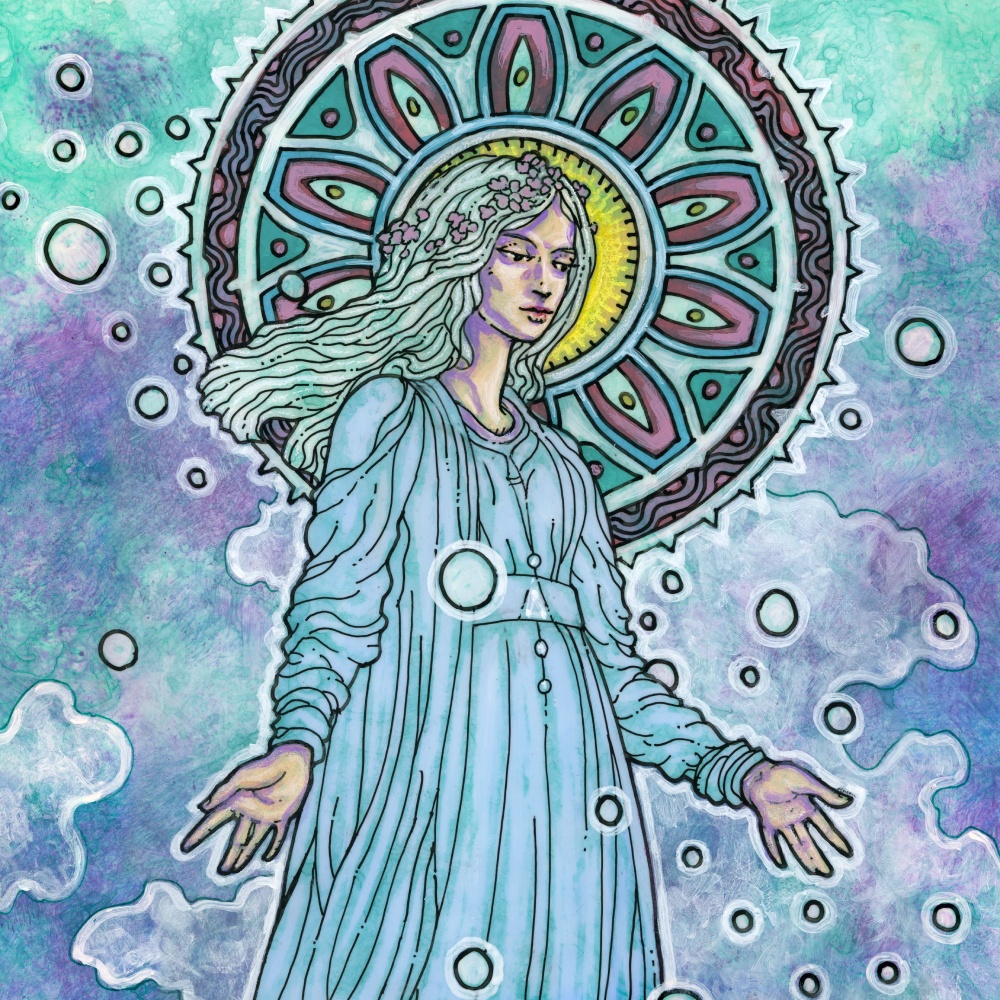
The Awakening: Creating a Portrait of Ireland’s White Lady of Newgrange
Jim Fitzpatrick | January 2026
PS: I will be posting this image on social media but not this commentary, which is personal.
Touching the Intangible
This is not one of my usual mythological female images. It’s an attempt to capture a centuries-old spiritual presence—one that is both contemporary and deep-rooted, held in the resonant voice of Irish myth yet seen as a living presence.
I wasn’t looking for inspiration. My mind was elsewhere, focused on the martyrs of the 1798 rebellion. But this took over. It started as a sketch and went from there, all of its own volition.
I did not find her. She found me.
This image came spontaneously and demanded my attention. I would love to claim I had a vision, but the truth is simpler: like any artwork of consequence, it came from deep within, from somewhere I cannot easily explain. I’ll attribute it to compulsive artistic inspiration stretching back to my childhood.
Childhood Visions at Newgrange
At age 12, during my first visit to Newgrange’s megalithic tumulus in County Meath, I had a series of visionary dreams. Perhaps they were induced by medications during my two-year sanatorium treatment for TB. These were weird, dystopian hallucinations, many centered on Newgrange—the tunnel inwards to the inner chamber, and the ‘White Lady’ stories I heard on that first visit.
I felt claustrophobic stooping as we entered the darkness of then-unexcavated Newgrange. We followed a guide with a bicycle lamp, crawling toward the large chamber. It was full of mystery and unforgettable excitement.
As a religious boy, I related these experiences to my fervent Catholicism and the apparitions at Fatima. As I grew older, I realized this was something separate—more connected to folklore and Ireland’s ancient past than organized religion.
Slowly, compulsion took over. In mid-February 2025, I started this strange painting. After many iterations, I finally let it go and left it as it wanted to be left.
The Creation of the Image
This enigmatic work, begun in mid-February 2025, will probably never be properly finished. I like to control my artistic output, but this one had a life of its own.
The work was inspired by my childhood visit to Newgrange and, more recently, by an old RTÉ programme clip from the ‘Radharc’ series (1960s) that resurfaced on YouTube. Once I revisited it, I was hooked.
The Artwork
My interpretation of the ‘White Lady’ is not meant to be realistic. She represents a feeling, an emotion—an intervention by the eternal divine feminine reminding us that another, more spiritual dimension exists alongside our own.
The figure is ethereal, a vision, a spirit. Even knowing this isn’t a real representation, somehow this is what I produced, which puzzles me.
Her face is not of my choosing. It created itself despite my efforts to make her more youthful and in my own style. The subject is, in reality, a faceless visionary spirit projecting an image—perhaps an illusion—that seems warm and loving. I believe this is a force for good, a being of high intelligence ready to help us, as we’ve seen with apparitions worldwide.
This face resisted change, which is ridiculous but true. Remember, this is a spirit projecting an illusion we find comforting, not a three-dimensional human—much like the Catholic Church transformed the Fatima vision into human-looking statues, though the witnesses never described human features.
So what is happening here? I have no idea.
Here she is: a vibrant supernatural shapeshifter, a luminous feminine presence unsettling in all its archetypal familiarity.
Newgrange and the White Lady
Anne Hickey’s Testimony
The Radharc series covered ancient beliefs and Irish history, but the episode I remember best featured Newgrange caretaker and guide Anne Hickey, then in her 90s, who had worked at the site for over 50 years. |

Link: Via RTÉ Archives | Environment | Newgrange Revelations
Anne Hickey was deeply familiar with both the physical monument and local oral traditions. She became a vital source of oral history about how people spoke of fleeting visions and mysterious presences around Newgrange, reinterpreted in folk memory as fairies or otherworldly figures.
Her testimony anchors the White Lady not in modern speculation but in living Irish folk memory—the kind that existed before archaeology, television, or tourism. She wasn’t repeating hearsay; she was a carrier of unbroken oral memory.
In Irish folklore, who speaks matters as much as what is said.
She described a woman in white seen near the mound, initially mistaken for a living person who vanishes when approached. This is a classic Irish Otherworld encounter: precise, restrained, undramatic. That restraint marks authenticity.
For as long as I can remember, I’ve been intrigued by Ireland’s obsession with the supernatural—the strange and weird that permeates our ancient Celtic, Gallic, and Gaelic folk traditions.
The ‘White Lady’ represents spirituality in its most refined form. In Ireland, like Fatima, we have the ‘Miracle at Knock’—witnessed by many in Mayo in 1879. I always believed it was a magic lantern projection on a gable wall. But now I’m not so sure.
Understanding the White Lady
White-clad female figures frequently appear in fairy lore and land-spirit stories—places where the Otherworld touches the human world. These figures are fleeting, ambiguous, tied to land and memory rather than prophecy.
Why She Is Not a Banshee (Bean Shí)
The modern ear hears ‘White Lady’ and thinks banshee—a category error.
The Bean Shí attaches to families, not places. She wails before death and is as much heard as seen.
The White Lady of Newgrange attaches to the mound itself. Silent, appearing at threshold times, she marks presence rather than predicting death. She belongs to an older tradition than the banshee.
Bean an Tulaigh (Woman of the Mound)
In pre-Christian Ireland, before named goddesses, there existed place-women:
Women of hills
Women of stones
Women of wells
Women of fords
These weren’t “fairies” in the Victorian sense. They were embodied land memory.
The White Lady is best understood as the Woman of the Mound—a visible expression of the site’s awareness. She isn’t guarding treasure. She is the treasure: memory made visible.
Why She Appears as “White”
In Irish folk cosmology, white doesn’t mean purity or ghostliness.
Newgrange was once faced in brilliant white quartz. Through mist or dawn light, the mound would have glowed. The White Lady isn’t dressed in white—she is of the mound’s original radiance.
The Irish Rule of Approach
One telling detail in Hickey’s account: the White Lady disappears when approached.
This places the story squarely in authentic Irish lore. In Irish tradition, the Otherworld is visible only at the edge of attention. Direct pursuit breaks the vision. These beings aren’t meant to be confronted.
Newgrange as Liminal Intelligence
Within Brú na Bóinne, Newgrange was never just a tomb. It’s a monument of the ages—older than the pyramids and Stonehenge by a thousand years or more, possibly even older, built on a more ancient wooden, palisaded site.
Current archaeology dates Newgrange at over 5,000 years old, but this date keeps being revised downward. Who knows how old this ritual site truly is? Another mystery for the ages, another piece of ancient Irish culture and religion.
The White Lady personifies that ancient culture. That’s why artists, caretakers, and solitary walkers see her—not crowds.
Conclusion: The Awakening
This apparition is neither saviour nor herald of doom, but perhaps a messenger foretelling events that need attention. That’s why her appearance feels profound and unsettling.
Beyond that, I cannot say what this means.
But my belief is that this work does what its title suggests:
Our world, our planet, our children are in transition.
We have had enough of discord, conflict and deliberate division
We are collectively coming together and rejecting the old norms of hatred and conflict.
‘The Awakening’ has only just begun.
—Jim FitzPatrick, January 2026
